
We won the India-EU Ideathon 2025 with a technology solution for marine plastic pollution
Universal Plastic · 2026
Every plastic collection can generate valuable information to help us understand marine pollution. With digital technology, verifiable data and collaboration between communities, we can turn these actions into knowledge that helps make better decisions for the ocean.
At Universal Plastic, we develop technology solutions that connect local action with information systems capable of measuring, verifying and giving visibility to the results of plastic collections. Our goal is for the effort of communities to help generate useful evidence to improve the monitoring of marine plastic pollution and strengthen ocean resilience.
This vision led us to take part, together with the Indian organisation Muskurate Raho, in the India-EU Ideathon on Combating Marine Plastic Pollution 2025, where our team was recognised as one of the three winners for its proposal to improve the measurement and prevention of marine plastic pollution.
The recognition reflects the potential of combining technology developed in Spain with the knowledge and experience of organisations working directly on the ground in India.

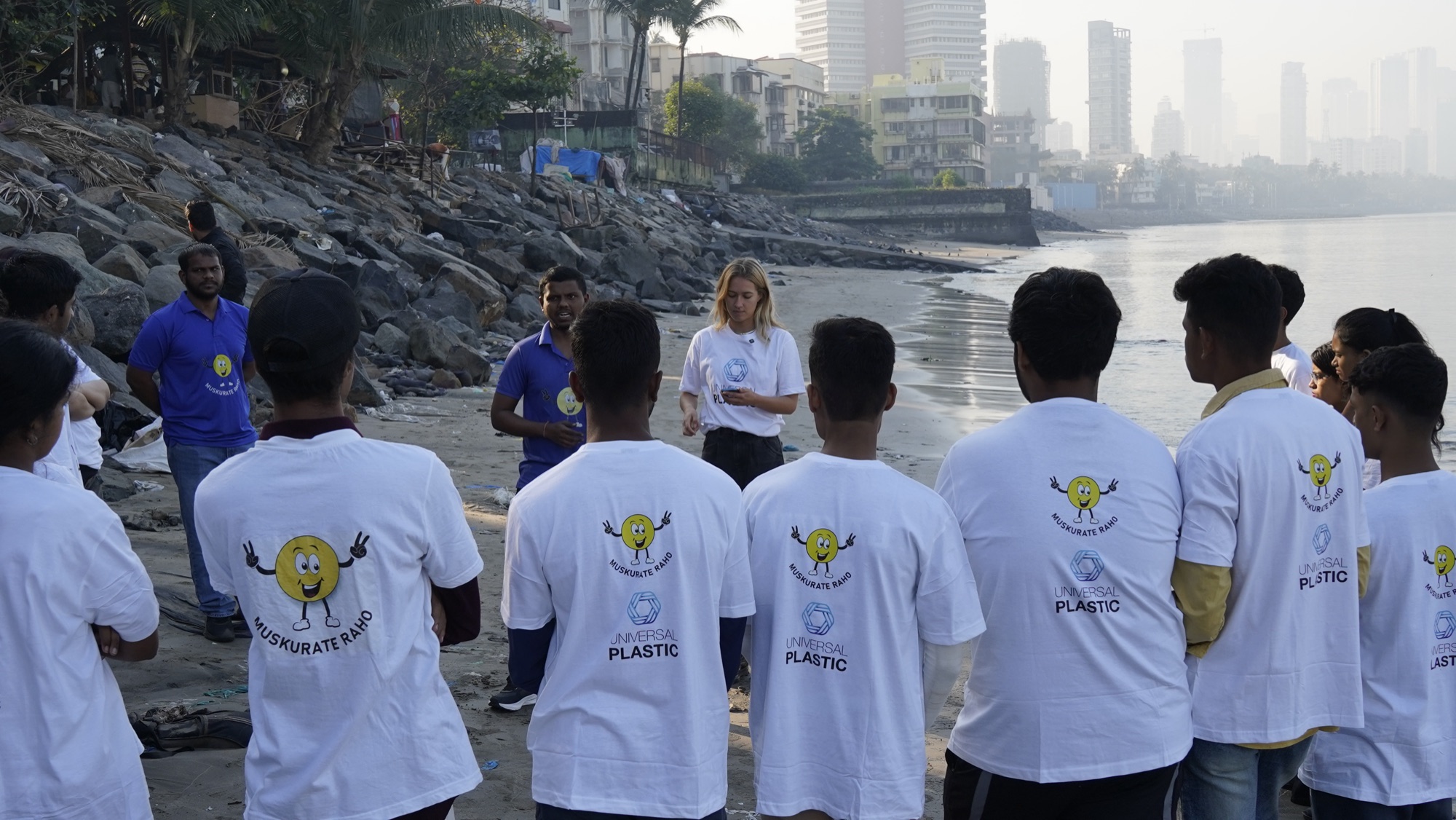
Muskurate Raho volunteers gathered on the coast before a collection.
A shared challenge between India and Europe
The India-EU Ideathon was held under the India-EU Trade and Technology Council and culminated in 2025 in Bhubaneswar, India. The initiative brought together representatives from science, startups, business, institutions and civil society organisations to develop solutions to marine plastic pollution.
The programme addressed three main challenges: improving the identification and monitoring of marine plastics, developing technologies for their removal, and encouraging community participation in preventing pollution.
The European Commission announced three winning teams, one for each area of innovation.
Our participation focused on connecting Universal Plastic’s technological capabilities with Muskurate Raho’s local experience, exploring how the digitisation of plastic collections can make it easier to track results and strengthen collaboration between organisations.

Final ceremony of the India-EU Ideathon in Bhubaneswar, with the prize cheque.
Turning local action into verifiable data
In different parts of the world, communities and organisations carry out plastic collections on beaches, rivers and coastal areas. These initiatives provide first-hand knowledge about pollution in their territories and mobilise people who care about their environment.
However, recording and sharing results consistently remains a challenge. The lack of structured information makes it harder to compare interventions, identify pollution patterns and give visibility to the work being done. The proposal developed for India tackles this challenge by combining digital technology with community participation.
With Universal Plastic’s tools, organisations can document their plastic collections by including information such as geographic location, date, weight collected and photographic evidence. These records make it possible to build traceable information about each intervention, making it easier to track results and communicate the work done more transparently.
In addition, when data is structured using common criteria and goes through appropriate review and verification processes, it can help identify priority areas, improve the planning of future interventions and generate useful knowledge for other organisations and institutions.
This approach is part of our vision as a science and technology company: connecting data from local actions with digital tools that turn scattered information into actionable evidence.

Plastic waste among the rocks of a beach in Mumbai.

Muskurate Raho’s profile in the Universal Plastic app.
Muskurate Raho and the value of local knowledge
Technology is more useful when it responds to the needs of those who work directly on the ground. Local communities know the characteristics of their coasts and rivers, identify the places where plastic accumulates and understand the challenges of organising collection efforts.
In India, Muskurate Raho represents the value of this knowledge and of community commitment. Its experience organising plastic collections provides a fundamental perspective for developing tools adapted to the real conditions of each territory.
Our collaboration in the Ideathon made it possible to connect this experience with Universal Plastic’s digital capabilities, exploring new ways to record the results of interventions and extend their visibility.
This combination also reflects one of our working principles: global scale, local action. Digital solutions can make it easier to connect initiatives in different territories, while communities provide the knowledge needed for their application to be relevant and useful.
Collection with Muskurate Raho and Universal Plastic at Mahim Beach, Mumbai.
Technology and collaboration to strengthen ocean resilience
Marine plastic pollution is a shared challenge that requires cooperation between communities, businesses, institutions and scientific organisations. Initiatives such as the India-EU Ideathon connect complementary perspectives and capabilities, make it easier to exchange knowledge and explore solutions that can be adapted to different geographic contexts.
For Universal Plastic, taking part in this programme alongside Muskurate Raho is an opportunity to apply our technology in a new context and keep developing tools that connect collective action with verifiable data.
It also reinforces our commitment to a digital infrastructure capable of improving the traceability of interventions and contributing to a more complete understanding of marine plastic pollution.
The recognition obtained at the Ideathon is a boost to keep exploring this model of collaboration between India and Europe, drawing on applied science, digital intelligence and the experience of communities.

Volunteers carrying a bag of collected waste during the day.
From collaboration to measurable impact
Every plastic collection is an opportunity to better understand the state of our coastal ecosystems and the work of those who contribute to their recovery. By connecting these interventions with digital tools, we can improve the quality of the information available, make results more visible and support evidence-based decisions.
At Universal Plastic, we will keep promoting collaboration between technology, science and communities to turn local action into shared knowledge and help strengthen ocean resilience.
Does your organisation work to reduce marine plastic pollution?
Get to know Universal Plastic and find out how we can collaborate to generate verifiable data, give visibility to results and extend the reach of local actions.
How do we measure the impact of removing plastic from the coast?
A waste collection can be much more than a one-off action: when it is documented, it becomes useful information. Discover how we measure its impact on biodiversity, ecosystems and the blue economy.