TalentUO 2026 Hackathon: the economic value of a plastic-free coastline
Universal Plastic · 2026
From Asturias, where we are based, we brought to the University of Oviedo a question that connects technology, biodiversity and economics: how to translate removing plastic from the coast into economic benefits.
What is a plastic-free coastline worth?
A plastic-free coastline is much more than a pretty picture. It is a place to enjoy, an environment that economic activities depend on, and an ecosystem that deserves to be protected in its own right.
But when it comes to deciding where to act or justifying an investment, a difficult question arises: how do we express the value of that improvement in economic terms?
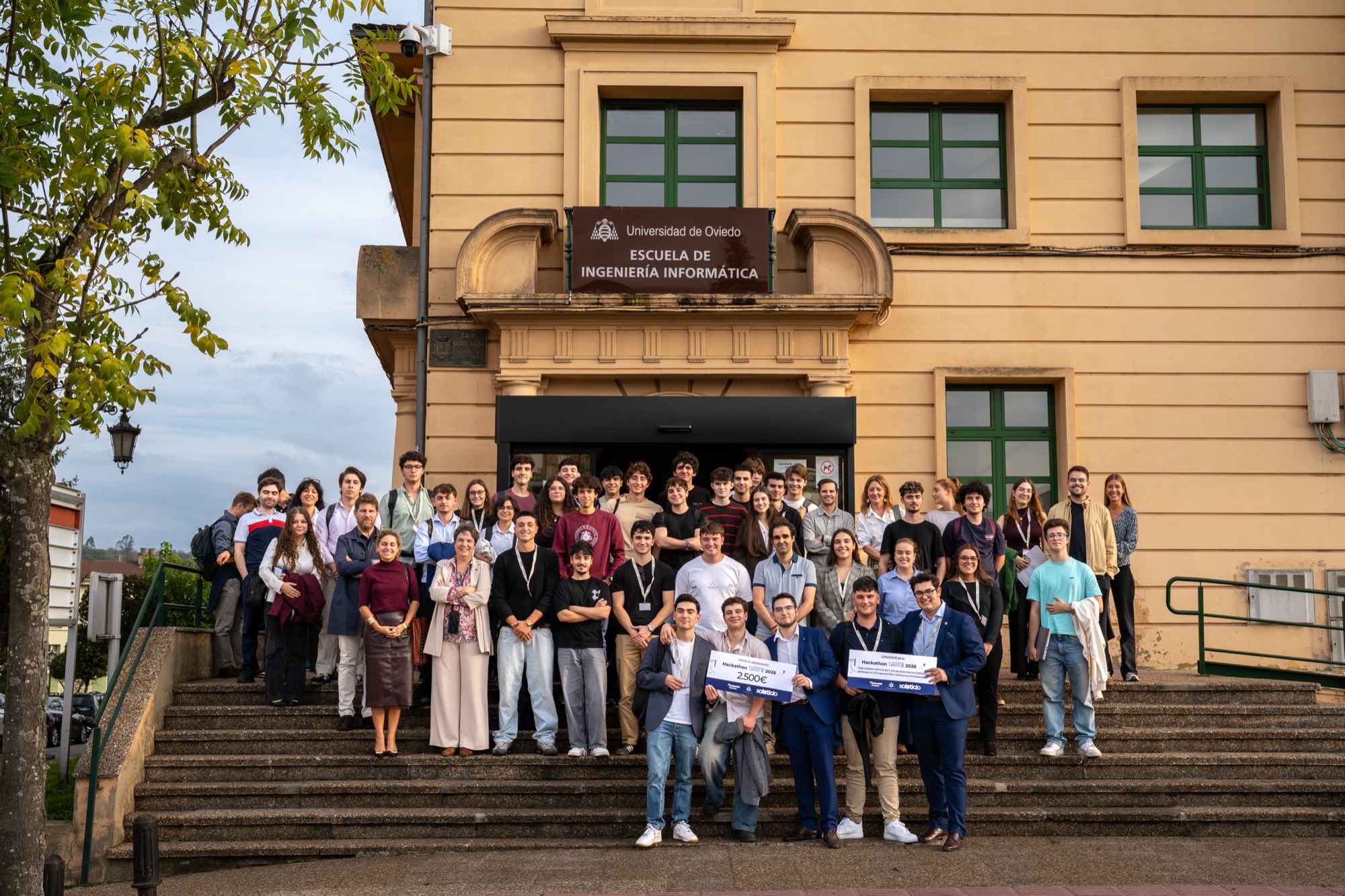
That was the question Universal Plastic posed at the fifth edition of the TalentUO 2026 Hackathon, held on 15 and 16 October at the School of Computer Engineering of the University of Oviedo, organised by Solsticio. It was a gathering where university talent took on real challenges and explored how to turn knowledge and ideas into applied solutions.

A real challenge: from kilos collected to value generated
Logging a collection tells us where we acted, when, and how much plastic was removed. That information is essential, as we saw in Beyond the kilos. But the weight of the waste does not tell the whole story.
What does that action mean for a fishing area? What benefits can it bring to a coastline tied to tourism and leisure? How should we account for mangroves, reefs or marine protected areas? And what costs or losses could be avoided?
Our challenge, “What is the value of a plastic-free coastline?”, invited the teams to design a first methodology linking the reduction of plastic pollution to the economic value generated or the potential losses avoided.
This is not about putting a price on the ocean or reducing nature to a single number. It is about making visible the benefits that are often left out of decisions, without losing sight of the limits of the data or the complexity of ecosystems.
Two locations, one question
To ground the challenge, we proposed two cases close to mangroves: an operation in Curaçao, with 320 kg of plastic removed, and another in India, with 324 kg.
The quantities are very similar. The context is not.
In Curaçao, the information provided for the exercise also includes the proximity of a coral reef and a marine protected area. In India, the indicators provided highlight a larger number of species of commercial and tourist interest.
These cases let us explore an essential idea: a similar amount of plastic removed does not necessarily mean the same benefits everywhere.
The teams had collection data plus environmental and socioeconomic information to build their proposals. The challenge was to take the next step: identify which benefits could be estimated, from which sources and under which assumptions.
Much more than multiplying kilos by euros
A useful methodology has to explain where each estimate comes from. That is why the challenge opened several lines of work:
- Tourism and leisure: exploring how the environmental quality of the coastline can influence the experience of visitors and recreational activities.
- Fishing and other sea-related activities: considering potential damage avoided to nets, gear, engines and equipment, as well as interruptions to activity, a key piece of the blue economy.
- Cleanup and management: analysing costs and future needs that could be reduced, keeping these benefits separate from the cost of the intervention itself.
- Biodiversity and ecosystem services: studying how to include the benefits of healthy ecosystems using existing economic methodologies, in line with our biodiversity impact index.
Rigour lies in linking each benefit to the action, not in simply adding up numbers. Avoiding double counting, separating what is observed from what is assumed, and acknowledging what cannot yet be quantified are fundamental parts of the exercise.
We were not looking for a spectacular figure. We were looking for a methodology that can be defended, reproduced and improved.
O.R.C.A.: from challenge to first prototype
Sofía Alonso Ibáñez, Pablo Arboleya Piquero, Javier Martino García, Iván Rubio Martínez and Antonio Valdés took up the challenge and built O.R.C.A. — Ocean Resilience & Cost Analytics.
Their proposal combines an economic valuation model, focused on fishing, tourism and waste valorisation, with a map interface to explore different locations and plastic removal scenarios. The prototype lets users visualise the territorial context and consult estimates broken down by sector.
In just two days, the team turned a complex question into a concrete, visual proposal. It is a first approximation that opens new lines of work: checking the sources, reviewing the assumptions and validating the relationship between the plastic removed and the estimated benefits before using the results as evidence of impact.
Thank you to the team for their commitment, creativity and drive to take the challenge a step further.

Screenshot of the O.R.C.A. prototype developed by the team during the hackathon.
From the hackathon to Blue Resilience
This challenge connects to the development of Blue Resilience, Universal Plastic’s operational maritime intelligence engine, designed to measure and prioritise the impact of actions against pollution and for the protection of marine ecosystems.
Our app for citizen science lets people log collection actions with information on their location, quantity and the characteristics of the material removed. Our work on impact indicators adds environmental and socioeconomic context. Economic valuation adds a further layer: understanding better what benefits those actions can generate and how to use that information to guide decisions.
The hackathon proposals can be a starting point to keep researching this connection. The aim was not to get a final economic model in two days, but to move towards a solid base that can be developed and adapted to different locations.
From Asturias, connecting talent and territory
Universal Plastic is in Asturias, and being part of the life of the territory also means getting involved in activities that connect university, business and talent. Taking part in TalentUO 2026 was a way to bring a real challenge to that space of collaboration and strengthen our ties with the Asturian innovation ecosystem, the same one that already links us to the University of Oviedo.
We want to help make Asturias a place where talent finds opportunities to develop projects with impact, and a territory able to attract new ideas, professionals and collaborations. Bringing students challenges such as protecting the oceans shows that global-scale problems can be tackled from here.
Taking part in local initiatives is part of that commitment: innovating from Asturias, collaborating with our surroundings and contributing to the appeal of the territory as a place to research, start a business and build a career.
University talent for questions that matter
Solsticio, formerly U4IMPACT, is a company based in Oviedo that connects organisations, universities and students around real challenges. Its university-business collaboration approach fits the spirit of this challenge: bringing open problems into the classroom that call for creativity, knowledge and the ability to work across disciplines.
For Universal Plastic, taking part meant sharing an applied research question with a new generation of professionals. A question where computing and data meet economics and environmental science.
Thank you to Solsticio (formerly U4Impact), to Fundación Banco Sabadell and to the University of Oviedo for making this meeting space between students and companies possible, working together on real challenges.
The challenge also connects to SDGs 14 — Life Below Water, 12 — Responsible Consumption and Production and 8 — Decent Work and Economic Growth: reducing pollution, protecting ecosystems and recognising their link to coastal activities and communities.
Because protecting the sea also means learning to better tell what we gain by caring for it.
Kilos tell us how much plastic we remove. The challenge is understanding everything we can protect by doing so.
How do we measure the impact of removing plastic from the coast?
Discover how we are working to build a fuller picture of the impact of plastic pollution on biodiversity, ecosystems and the blue economy.